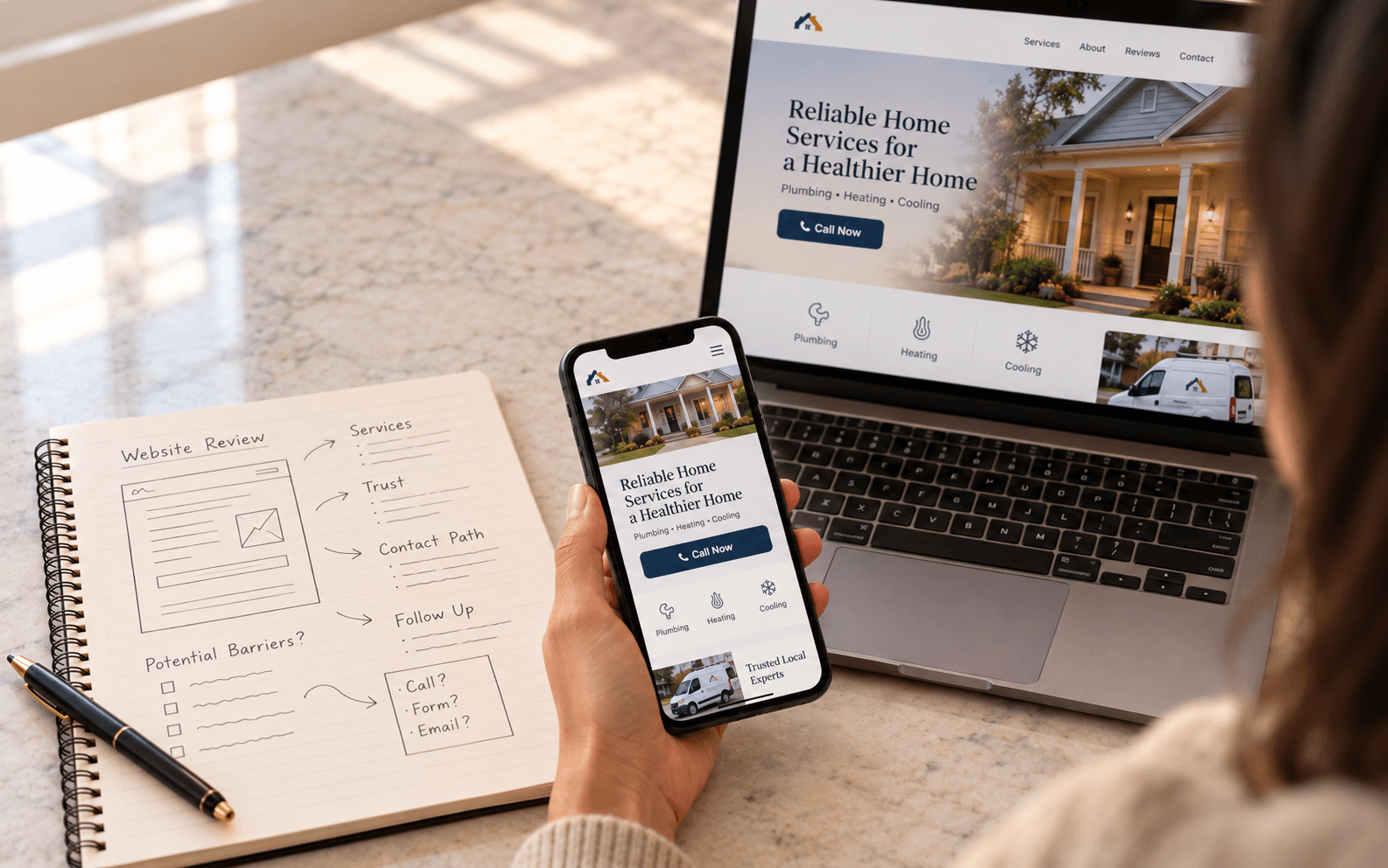
Why Your Local Business Website Isn’t Getting More Calls or Inquiries
Your website looks decent. It explains your services. It has a contact page. But the phone isn't ringing as often as you'd like, and you're not sure whether the website is helping.
It's tempting to assume you need more traffic, better SEO, or an entirely new site. Any of those could be useful. But before spending money, I'd want to answer a simpler question: Where is the customer getting stuck?
First, figure out which problem you actually have
"Our website isn't bringing in business" can describe several different situations. They don't call for the same fix.
| What you're seeing | What it might mean | Check first |
|---|---|---|
| Very few relevant visitors | The right customers may not be finding you | Google Business Profile, local search presence, referrals, and search visibility |
| Visitors, but few calls or inquiries | The service, proof, or next step may not be clear | Homepage and service-page clarity, mobile experience, and contact paths |
| Inquiries arrive, but few become jobs | The issue may be fit, response, pricing expectations, availability, or follow-up | Actual inquiries, response ownership, estimates, and booked work |
If you don't yet have trustworthy website numbers, that's fine. Start with what you do know: recent inquiries, how customers say they found you, and whether your calls and forms are reaching someone. You don't need a complicated dashboard to begin.
Five things I'd check before recommending more marketing
1. Can people quickly tell what you do and where you work?
Imagine someone searching for help with a specific problem. They arrive on your homepage and have a few seconds to decide whether to stay.
Can they tell what services you offer? Which communities you serve? Whether you handle the kind of job they need?
Broad claims like "quality service" and "customer satisfaction" don't answer those questions. Neither does a long list of every service and city you've ever served.
Lead with the work you want more of and the places you can actually serve. Make the rest easy to find without asking visitors to sort through everything at once.
2. Do you give people a reason to trust you?
Local customers often have real reasons to be cautious. They're inviting someone into a home or business, making a financial decision, or trusting a provider with something important.
A polished design helps, but it isn't the same as proof.
Show what makes your business credible: relevant customer reviews, real photographs of your work, applicable licenses or credentials, useful experience, and clear expectations about the service. Use what you can support, not inflated claims.
Put the most relevant proof near the decision it supports. A review about prompt, careful electrical repair is more useful beside an electrical repair service than buried on a separate testimonials page.
3. Is the next step obvious on a phone?
For many local services, someone would rather call than fill out a long form. If a phone call is your preferred first step, treat it that way.
Open the website on your phone. Can you find the number quickly? Is it tappable? Do buttons clearly say what happens next? Does a floating banner cover the page or make navigation frustrating?
It's possible to have plenty of calls to action and still make the right action unclear. "Get a Quote," "Schedule," "Contact Us," and "Call Now" shouldn't compete unless those really are distinct, useful choices.
Choose one primary action, then make the secondary option available for people who prefer it.
4. Does the inquiry actually reach the right person?
This is easy to overlook because a form can look like it's working even when the handoff isn't dependable.
Submit a test inquiry and follow it all the way through. Does it arrive in the intended inbox? Can the recipient reply directly? Is the confirmation message readable? Does it set an honest expectation for what happens next?
If an important message lands in the wrong inbox—or no one owns it—more website traffic won't solve the problem.
5. Does the business follow through after someone reaches out?
The website's job doesn't end when someone clicks a button. A missed call, an unanswered form, or an estimate without a clear next step can interrupt an otherwise good customer experience.
Ask who owns new inquiries and what happens if that person is busy. The answer doesn't need to involve a new CRM. It may simply require clearer responsibility, a shared place to see open inquiries, and one dependable next action.
I've encountered these kinds of issues in local-business website work: unclear service priorities, mobile contact friction, and form handling that needed to be tested. They're not always reasons to start over. Often the better first move is to correct the existing customer path.
For the handoff itself, see a simple approach to lead follow-up.
A 15-minute website check you can do yourself
You don't need a formal audit to spot some of the most obvious problems. Try this:
- Open your homepage on your phone as if you've never heard of the business. Can you identify the main service, service area, and next step without hunting?
- Visit one important service page. Does it answer the questions a real customer would ask? Is there relevant proof, or mostly generic promises?
- Test the contact path. Check the call button and, if you control the receiving inbox, submit a real test form. Confirm that the message arrives and the next step is clear.
- Look at your last few legitimate inquiries. How did those customers find you? Which ones were a good fit? Did they receive a response? Which became booked work?
Write down the two or three issues that seem most likely to matter. Don't turn this into a 40-item redesign checklist.
Fix the constraint, not the symptom
If the right customers aren't reaching the site, clearer copy alone won't create demand. You may need to improve your local visibility, strengthen referral pathways, or make your existing Google presence more useful.
If customers are finding you but aren't contacting you, look more closely at messaging, reputation, and the next step before buying more traffic.
And if inquiries are already arriving but not becoming work, investigate lead quality, availability, response, and follow-up. The website may not be the main constraint at all.
This is the reason I use a four-part framework—Visibility, Reputation, Messaging, and Action. It helps narrow the problem before choosing the tactic.
Measure what happens after the click
Website visits, call-button clicks, and form submissions can be useful indicators. But a call click isn't necessarily a completed call, and an inquiry isn't necessarily a good-fit customer.
For an owner-led business, I'd rather begin with a few trustworthy answers: How many legitimate inquiries came in? How many were a good fit? Were they answered? How many became booked work? When you know the source, record it without forcing a guess.
A small-business growth scorecard can help you keep that simple.
Before you rebuild, find the point of friction
Sometimes a website really does need a substantial rebuild. But sometimes it needs clearer services, more visible customer proof, a better mobile call button, or a contact process that reliably works.
Start with the actual customer journey. Fix the clearest problem. Then watch what changes before adding the next project.
Your website doesn't have to impress everyone. It needs to help the right customer understand what you offer, feel confident enough to reach out, and get a dependable next step.
Keep reading
Related insights
A practical next step
Not sure where this fits in your business?
The free Local Business Growth Snapshot can help you identify which part of your marketing may deserve attention first.
Already know you’d like another set of eyes on it? Book a free discovery call.