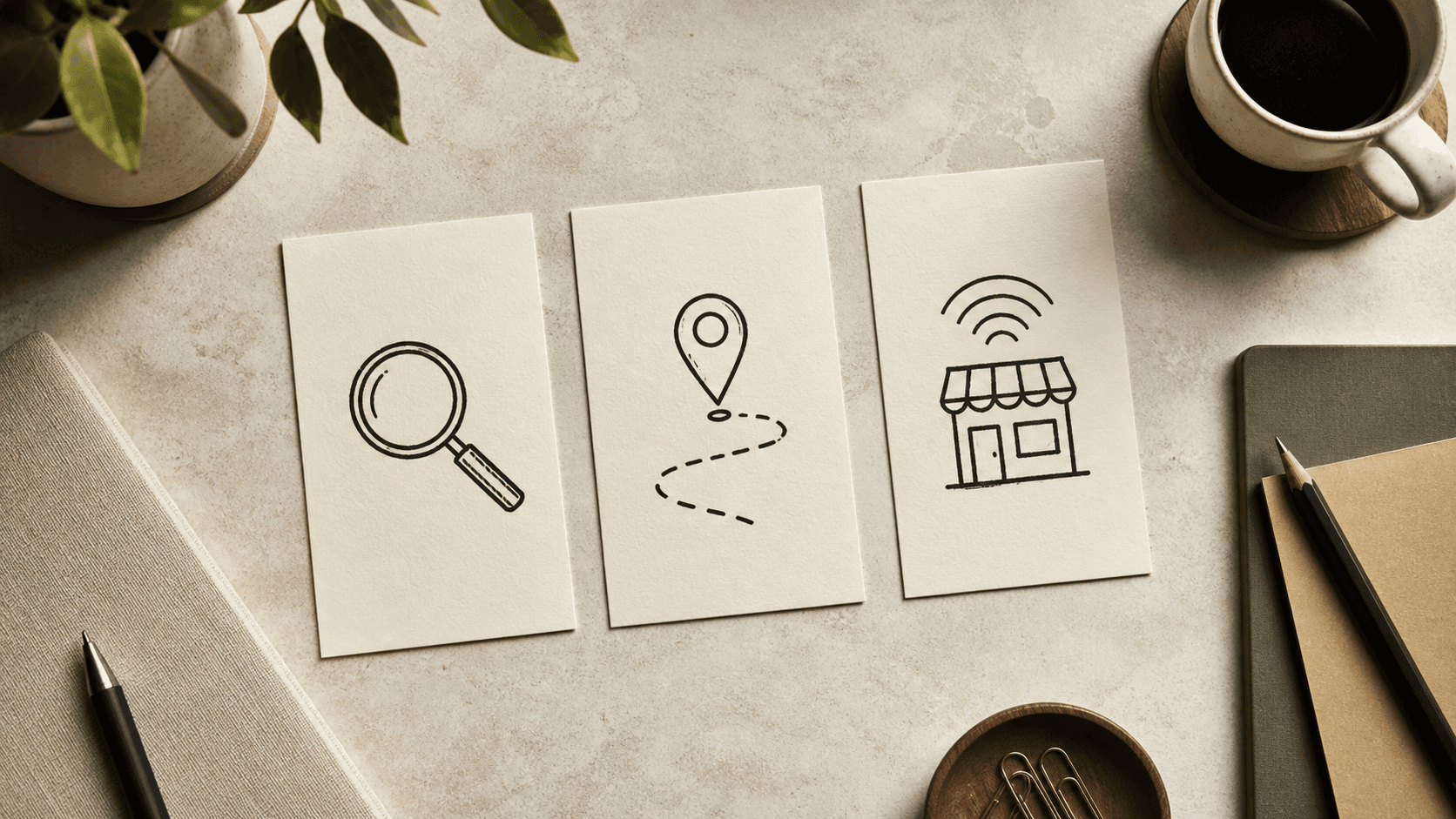
How Visibility Actually Works in a Business
Visibility is often reduced to rankings. Rankings matter, especially when someone is actively searching for a local service, but they are only one part of how a business becomes known and considered.
A person may hear the name from a neighbor, see a truck, pass the storefront, notice a community partnership, search the business later, read reviews, and then call. Visibility is the whole discovery path.
A simple visibility map
| Channel | What it helps with | How to measure it | Common weakness |
|---|---|---|---|
| Branded search | Helping people verify a business they already know | Name searches, profile views, direct visits, and calls | Outdated or conflicting information |
| Non-branded local search | Introducing the business to people looking by need | Service queries, local impressions, website visits, and qualified inquiries | Weak relevance, distance, or website support |
| Referrals | Transferring trust through customers and professional contacts | Ask each new customer who referred them | Dependence on a few people or no consistent reminder |
| Partnerships | Reaching adjacent audiences through credible relationships | Introductions, partner links, events, and resulting inquiries | Partnerships exist socially but are not maintained |
| Physical and community presence | Building familiarity in the places the business serves | Direct mentions, walk-ins, event conversations, and branded searches | The offline identity does not connect clearly to the online one |
The purpose of the map is not to make every channel equally important. It helps you see which paths already work and which path is carrying too much weight.
Branded discovery and non-branded discovery are different
Someone searching your exact business name is already aware of you. They may be checking hours, reading reviews, looking for a phone number, or deciding whether the recommendation they received feels credible.
Someone searching “electrician near me” or “coffee shop open now” has not necessarily chosen a business. That search is a discovery opportunity.
Both matter:
- Branded discovery tests whether your online presence confirms what someone heard elsewhere.
- Non-branded discovery tests whether the business can appear for a relevant need before the customer knows the name.
This is why a business can have strong word of mouth and still feel invisible in search—or rank for a service and still lose the decision when its profile and website feel unclear.
Local search is shaped by relevance, distance, and prominence
Google describes local results through three main factors: relevance, distance, and prominence.
- Relevance is how well the profile and broader business information match what someone is looking for.
- Distance is the business’s proximity to the searcher or the location used in the search.
- Prominence is how established and well known the business appears, using signals such as links and reviews.
These factors explain why there is no single switch for local visibility. Complete information can strengthen relevance. Reviews and real local mentions can support prominence. Neither removes physical distance.
If the profile is missing, suspended, or visible only for the business name, use the separate guide to diagnose why a Google Business Profile is not showing.
Findable is not the same as understandable
A result can appear and still fail to help a customer.
When someone lands on the profile or website, they should be able to understand:
- what the business does
- where or how it serves customers
- whether it handles the problem they have
- when and how to make contact
- what evidence supports the claims
An accurate Google Business Profile setup gives searchers a useful first layer. The website should then provide enough context to make the next decision easier.
If people find the business but hesitate, the issue may be customer trust rather than visibility.
Measure action, not position alone
A ranking report can show where a business appeared for a selected query from a selected location. It cannot explain the entire customer path.
Add business signals:
- how new customers say they found you
- branded and non-branded search patterns
- profile calls, website clicks, messages, bookings, or direction requests where available
- qualified inquiries by source
- referrals and partner introductions
Google’s Business Profile performance documentation explains the profile interaction data owners can review. Use it alongside calls, forms, bookings, and real customer conversations.
A short visibility checklist
Work through these in order:
- Search the exact business name and confirm that the public information is accurate.
- Search the main service from a few realistic locations without assuming one result represents everyone.
- Ask recent customers how they first heard about the business.
- Confirm that the profile and homepage explain the same core service and geography.
- Look for one discovery path that is weak and worth improving.
- Track inquiries and customer actions long enough to see a pattern.
Improve the path that matters
Good work does not automatically create visibility. More tactics do not automatically create useful visibility either.
The practical goal is to make the business easier for the right people to discover, understand, and verify. Start with the path customers already use, remove the clearest friction, and measure whether better discovery produces better-fit conversations.
Sources and further reading
Keep reading
Related insights
A practical next step
Not sure where this fits in your business?
The free Local Business Growth Snapshot can help you identify which part of your marketing may deserve attention first.
Already know you’d like another set of eyes on it? Book a free discovery call.